John Gierach has been called the Father of the Modern Trout Bum, and while he'd suggest he's not
The Trout Bum -- just the one who happened to write about the lifestyle first -- he's still fly fishing's best-selling contemporary writer.
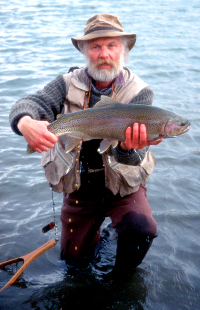
As testament to his broad appeal, all 16 of his essay books -- dating back to the original Trout Bum in 1986 -- are still in print. In a small publishing niche -- where 4,000 books is a pretty good run for an essay title -- Gierach's hardcovers and paperbacks sell upwards of 60,000-70,000 books per title.
In other words, not only does Gierach have a lot of fans, he's one of the tiny handful of fly fishing writers (some suggest he's the
only writer) making a decent living in the fly fishing genre.
He's also an interesting interview; he's remarkably unguarded, and as a result, the conversation tends to take on interesting shapes. As an interviewer, you're willing to take a few chances to see what happens.
A note about this interview; Gierach and I talked at length and he also answered a few questions via email, and while I tried to avoid transcription errors, any odd Gierach phrasings or other errors are the result of my frantic scribbling. I
did rearrange the order of the larger subject areas, and at times chopped away some of the less-relevant digressions.
Without further qualification...
Gierach On "No Shortage Of Good Days"
Q: In an interview, you suggested your earlier books were cobbled-together essay collections, but that later efforts are actually books that have been pieced out as essays. Which of those best describes No Shortage of Good Days?Actually, I would say this new one is more on that older model. I think what I meant is that I have a book in mind, and I sometimes write the essays that way. I sort of carry a book in my mind, but it's not like I have an outline already written.
I'm an instinctive writer; I don't think about this stuff. I suspect I'm a guy who has been picking away at this same theme for the last 16 books.
Q: That theme being?My theme is how do you live in the world as it is, while that world really tries to step on that? That's really the only question isn't it; how do you live?
Q: You refer to what I'll call "fly fishing's class wars" a bit more here than in prior books.I think I notice it more. I'm more aware of it because I end up stumbling into this other end of it. For the longest time I was just this little blue collar fly fishing hippie, and as I get more well known, I'm suddenly in these
places I never dreamed I'd find, or in some cases even existed.
If you're a writer -- hell a thinking human being -- you're bound to ask yourself exactly what this means. And what's my role, I'm here as a guest, and I paid for the plane ticket, but this trip would have cost a $100K if I'd paid for it, which you couldn't even do.
As something of a populist, how am I supposed to feel about this?
So yeah, you think about this stuff. It's just odd. This is how some people do it. We're all some kind of populists out here in the west, and you have to ask why isn't this public water?
I don't know if I have an answer.
Q: Your earlier books introduced us to people like AK Best, Mike Clark and Ed Engle -- and did so in some depth -- yet the people you write about these days don't seem as fully revealed to your readers. It that a conscious thing? Did you find people getting skittish about showing up in your books?The reason is that I don't know those people as well. I don't know Jim Babb as well as I know AK Best. I don't have the decades of history with some of these folks. And I may have said all there is to say about these guys, at least publicly. I mean I know a lot of stuff about AK Best that is none of my business, let alone any of yours, and maybe I've exhausted everything that needs to be publicly said.
When you're writing about your friends, they're kind of trusting you. I can reveal stuff about myself, but that's my decision.
And yes, I'm traveling more on my own. It's the worse recession in 30 years; everybody's broke.
Q: I'm tempted to label this the small stream book --- there might be more references to small streams in this book than there are in your actual small stream book.I'll have to check that, but these things are autobiographical, and that's what I've been doing a lot lately.
Q: How do you think you fit into a more extreme fly fishing media landscape?I'm suspicious of this trend towards making fly fishing an extreme sport. For example, on this book tour, I'm constantly asked "what do you think about the fly fishing film tour?"
I appreciate the adventure and the fishing they're showing and technically it's awesome stuff, but that's just not the sport I recognize. Maybe I'm a little more invested in this pastoral stuff.
Q: That's interesting. The video guys are trying make a living by going fishing and selling the experience, so in one sense, they're the new Gierachs, the new trout bums -- they're your children.I... I guess I can accept that. They're into a counter-culture head -- they live outside the mainstream.
And while I say I don't recognize the sport, I do recognize those guys. Those are bohemian guys who don't give a shit what anyone thinks about what they're doing -- they're doing it for love, and I certainly recognize and understand that.
And those guys will grow up.
Q: In our earlier interview I compared Trout Bum to Kerouac's On the Road, the idea being Trout Bum afforded fly fishers permission to view the sport -- which was saddled with a painfully highbrow image -- in a different context. It was possible to see it from the perspective of a subsistence, almost hippie, nearly obsessive lifestyle that also happened to be no big deal.Again, I heard that a lot -- that I wrote some kind of counterculture testament. You weren't hearing about it, but what was going on was that there was a handful of guys in the West living this way; all these guys were exploring fly fishing as a possible path to enlightenment.
So while I think it's fair to say Trout Bum was counter-culture, it's also true I was just reporting what was going on. That's what journalists do -- they pick up the stuff they're doing and start talking about it.
Q: I'd suggest you've achieved a largely iconic status, yet you seem largely bemused by it, especially while someone is fawning over you in a vid...[Interrupting] Well, what would you do?
[
ED: Point taken.]
Gierach on Steelheading
You once said that fly fishing for steelhead was going to be "your next thing." Have you become one of those existentialist steelheaders?I do it as much as I can; but I'm in the wrong place. I'm too far away.
I try to get out twice a year; in some years it's only once. A couple times I didn't go at all. One problem I had was that I was always trying to fish in the winter, which seemed like a great deal; go out and catch a steelhead when the fishing here was limited.
Problem is the flows are unstable and you
plan a trip and the river's blown out and you go anyway -- which happened on one trip, when we probably shouldn't have even gone. I suppose you're kind of buffalo hunting -- you're doing something without much chance of success, but it's there to do, and you might as well do it.
I finally started fishing in the fall, which makes all the difference in the world. You can use floating lines, the fish are more predictable and it's not as cold.
Still,
fishing in winter is really compelling; I recently fished a river I've been spey casting with conventional lines without success. I had no idea what wasn't working, but my fly had no ability to get down.
Someone loaned me a new kind of sinking line and the clouds parted. The casting's great and you can rocket those things across the river. Of course I'm a fly fisherman, so I came home and got on the phone and called people and told them I've got these rods, now what do I need to do this kind of thing?
So the winter fish are hard, but they're still worth it. They're huge and they're bright and they're raspy and they still have sea lice on them.
It's worth it. It's just worth it.
You may only get one or a few, but it's like rhinoceros hunting; you don't bag thirty of them, you get your Teddy Roosevelt picture holding it and leave it at that. It's not about the body count, and more people should probably fish trout that way. They really should.
Q: You've been fly fishing for decades, yet when it comes to steelheading, you might be in the same boat as your average reader; it's something you don't do often enough to really stay sharp.That's right. Especially at first, when I was learning, I'd have trouble. But the last couple of times I've pretty much gone out and flubbed the first 2-3 casts, mostly because I was pushing with my top hand instead of pulling with the bottom. I'd remind myself to pull, and lately, I've recovered pretty quickly, and then I'm just fishing.
The thing I had to learn about spey casting was this; like so much in fly fishing, people make it more complicated than it has to be. I mean, It's a change of direction roll cast. You put that loop in the right spot and punch it, and it's going to go. You just have to remember to pull more on the bottom hand than the top hand.
Q: So why -- given the distance -- are you still doing it?I don't get jaded, but at the same time, I've been fly fishing for at least 35 years, and it's cool to do something new. There's an enthusiasm. And yes, it's kind of less important that I catch fish now.
If you really don't care about catching fish, you should just quit. But then, I write about actually catching fish a lot less than I used to.
My first time steelheading, I fished a week and caught two fish.
Q: You seem to have a predilection for that kind of difficult fishing -- you keep returning to it. You fished at least a week in Scotland without a bite, your Atlantic Salmon trips have been hardly any better, and now you're bombing around the Northwest to catch a couple fish over the course of a week.When I fish small streams, I tend to catch a lot of fish and that's great, but steelheading is very different. I know my local small streams pretty intimately and I've got the timing down, but with steelhead, you're suddenly playing chess against somebody who really knows what they're doing.
Especially when I go steelheading in the fall, I'll come off my small creeks -- which I fish about as well as anybody and I catch a lot of fish, and then I'm not.
And it's really interesting to go out to somewhere and fish eight hours a day for a week and not catch anything, which is still really interesting to me.
It's hard and it kind of makes you dig a little deeper -- the idea that I'm going to fish my brains out and fish as well as I can and maybe I'll catch one, maybe I won't.
I've been doing this a long time, and there's a lot of water within a day's drive of my home I still haven't fished yet. The stuff you know still applies, but there's always some new wrinkle you have to work out. That's just fascinating to me.
Gierach On Writing For a Living
Q: Editors of fly fishing magazines have admitted their pay rates essentially haven't gone up since the 70s, and you're probably one of two writers making a living in the fly fishing space. Have things gotten better or worse for writers in the fly fishing space?The only reason I make a living is Simon && Schuster. There was a time when it possible to make a passable living freelancing [articles]. But that's not the case any more.
This book is like my 16th; and they're all out there making money for me.
The guys now aren't making much money. I'm not sure I would be able to do today what I did then.
I'm frankly glad I don't have to figure it out.
Q: What do you think about fly fishing's online writers, the bloggers and ezine writers?The quality of the writing is there, but the density isn't. Something looks good and the idea is there, but then the essay just stops short. I don't know if people are going to stretch out, or if this is the way it's going.
Q: For a while you were writing for the New York Times; what's it like to be a trout bum writing for this monstrous newspaper?The problem was this; they were publishing one column a month, and that column would get bumped if a football player got a hangnail, and I called them and told them I couldn't keep writing columns that I wasn't going to get paid for.
The editor didn't get it, and so I asked her if she had someone else she could call. She mentioned another guy, and I told her to call him next time.
It was the New York Times and it was very prestigious, and I wasn't making any money.
Q: In the fly fishing niche -- where an essay book is doing pretty well if it sells 4,000 copies -- your first print runs are rumored to be in the 70,000 copy range. True?For my last book I think they printed 26,000 hardcover copies, so if you add in the the paperback sales, that number is probably close (
ED: I got the estimate from a well known book distributor.]
Q: That's a lot of books in this industry. Why have you sold so many books and endured so long?I have no absolutely no idea why that is; in private moments I'll start to think I'm really that good, but that never lasts. I really think it's because I've been around just so damned long.
Q: Have you ever heard of Imposter Syndrome?What's that?
Q: Every writer I've spoken to says that even after their first couple successes, they kept waiting to be discovered for the frauds they are.Oh yeah, sure. I'm still waiting.
Q: You've said you write mostly in the winter so you can fish during the warmer months; is that strictly true, or do your deadlines enforce a fairly regular writing routine?It's as true as I can make it, but of course the reality of deadlines keeps me working more or less year around. It would be more accurate to say that I allow myself as much time as I want or need in season to fish locally or travel. And I still get the vast majority of work done over the winter.
Q: If so, do you write every day or chase XXXX words per week, or...?I spend at least some time on the writing most of the days I'm home. That's usually composing or editing, but also sometimes writing to editors and my agent and the other business that inevitably comes up. My problem isn't forcing myself to write because I do it compulsively. My problem is forcing myself to stop for a while when I get stale.
I don't chase word counts. A few thousand words a day is great (although they could eventually end up dumped or seriously pruned back) but so is a good, solid paragraph. Even a morning where I end up shit-canning every word amounts to progress because I've eliminated one possibility.
Q: With so many essays and articles under your belt, do you begin with some kind of formal process (outline, brainstorm, etc), or are you comfortable simply diving in? If so, what do you do when the thing comes off the rails on the 1456th word?I like to start with an idea and a couple of thoughts about it and then dive in. I'm an instinctive, stream of consciousness writer, so I like to just turn over an interesting rock and see what crawls out.
When a story comes off the rails - and most do at one time or another - I leave it alone for a while. Sometimes it all comes clear the next morning. Other times it takes a month. Sometimes the problem is just the order of the story. A few months ago I had what I thought was a good lead, but it went nowhere. Then I realized it wasn't the lead, it was the conclusion. Once in a great while a story just stalls and I abandon it.
Q: What writing tools do you use, and are you a stickler about them - or are you largely word processor/editor agnostic?I use a computer. I wrote hundred of articles and three or four books on a typewriter way back when. I resisted computers, but after re-typing several book manuscripts, I opted for less drudgery.
Q: Any quirky writer behavior you'd like to reveal here for the first time ever (instantly embarrassing or endearing you to my readers?Nothing all that quirky or endearing. I drink lots of coffee, stare out the widow a lot, talk to the cats, take long hikes on afternoons when I'm not fishing, carry a notebook at all times. I do like to work in the morning when, as a poet friend says, the mind is still informed by the non-linear dream world. I don't know about that, but I do sometimes go to bed stuck and wake up knowing what comes next.
Q: With the rapid arrival of ebooks, have you wrangled with your publishers over things like ebook or other digital publishing issues? (e.g. some writers have rejected the 75%/25% royalty split publishers are trying to enforce on ebooks.)I've sold ebook rights to some older books (that were published before such things existed) and electronic rights have been included in more recent contracts. I get slightly better than the usual split, thanks to my agent.
Q: Has the rise of digital publishing affected your writing -- or the business end of things -- at all?Not that I can tell.
Q: You once said: "I happen to have fallen into this thing where I write mostly about fishing and outdoor sports but I could have gone another way." You're best known for your essays, but have you ever thought about branching out into fiction, or even writing a mainstream outdoor book?I've written and published some sporting fiction - most thinly fictionalized accounts of real events. I've also written a column for the last dozen years for the Redstone Review published in Lyons, Colorado that you could describe as politics/social commentary. To write a mainstream fishing book I'd have to be an expert fisherman, which I'm not.
Q: How did you end up writing fly fishing essays -- a market which supports few writers (and seems to be getting even less lucrative than in the past)?I started out doing it just for the money while I worked on what I thought would be a career as a "serious writer" (whatever that means.) Then it just became the place where two passions came together and that was that. Also, when I started it was a more lucrative market than it is now. But it wasn't a business decision. Anyone who takes up writing for the money is an idiot.
Q: You often mention Tom McGuane, Annie Dillard and Jim Harrison as favorite writers in part because they do very well what you're trying to do. Who else would you recommend to your readers?Alice Munro (new favorite), Richard Russo, Richard Ford, Scott Spencer, Larry Watson, Ernest Hemingway (the early Michigan stories and The Old Man and the Sea), John Casey, Ethan Canin, Ted Leeson, Tobias Wolff, James Galvin (The meadow), etc.
[ED: Gierach also said -- in relation to Thomas McGuane -- that:
I will admit right here in print that The Longest Silence is better than anything I've written.]
Q: You've been in the writing business for approximately a bazillion years; what mistakes do you see younger/novice writers making over and over?Worrying about showing how well they can write at the expense of serving the story they're telling. The best writing is usually transparent.
Q: Any advice for other writers looking to make a dent in outdoor writing?Beware of the Internet. If you want to make a living, you have to get paid.
Favorite Child Questions
Q: Can you point to a Gierach book (or even essay) as your favorite?My favorite book is always the most recent one. That's partly because it's still fresh and partly because I'm trying to get better and want to think my most recent work should be my best.
Q: Favorite small stream fly rod?My favorite for the last few years (ever since I got it) is a 7-foot 9-inch 4-weight bamboo made by Walter Babb of Sweetwater, Tennessee.
Q: Favorite species of trout?Hard to pick between cutthroats and brook trout.
Q: Favorite fishing truck?My current 2000 V-6 Nissan Frontier.
Older TU Posts Related To No Shortage of Good Days
Review of No Shortage of Good DaysGierach on fly fishing's class warsGierach on getting oldSmall stream syndromeToo cheap to pay someone to write