Finally — the last installment of my series on Phillipson Bamboo Fly Rods.
Missed the earlier installments? Click to read Part I and Part II. Otherwise, feel free to add Phillipson-related comments at the bottom.
Due to the length, you’ll have to click the “Read More” link below to read the whole thing.
Enjoy!
Bury Me With My Phillipson Bamboo Fly Rods — The Final Installment
What’s most remarkable about Phillipson’s bamboo fly rods is that – for all their fishability and bulletproof construction — they weren’t designed to empty the pocketbooks of the wealthy.
Phillipson’s rods – along with Heddons and Grangers (remember, Phillipson supervised Granger production after Goodwin Granger’s death in the early 1930s) – occupy a narrow niche in the fly rod continuum.
That niche? Production fly rods that cast and fish as well as any rod, but do so at a price that almost anyone could afford.
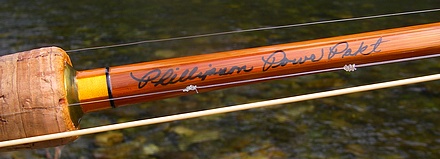
A varnished Power-Pakt (refinished).
A worthy goal, and his success in achieving it drives me to declare Bill Phillipson the most under-appreciated builder of the bamboo’s “Golden Age.â€
And — unlike so many of the more famous Eastern builders (who died paupers) – Phillipson’s rod building company was successful, and remained so after the market switched to fiberglass rods in the early 50s.
Phillipson’s Bamboo Fly Rods
While the prices for his rods varied – his early rods ranged from $20 to $75 – his least-expensive 8.5′ rod used the same exact taper as the most-expensive 8.5′ taper.
So while his high-end models featured high-graded cane, silk wraps and (sometimes) better reel seats than the cheaper models, they all fished pretty much the same.
When he started selling bamboo in 1946, his lineup was simple (from least to most expensive):
- Pacemaker
- Power-Pakt
- Paramount
- Premium
The next year he added the Paragon to the bottom of the line ($19.95) , but by all accounts, his Pacemaker was his most popular rod.
I’ve owned two Pacemakers and frankly, they fished on a par with my top-of-the-line Premiums – a reality that didn’t escape the rod buyers of the time.
With little difference between grades, all that’s really left are the different lengths, tapers and finishes, which varied over time.
For example, his varnished rods reigned supreme in the latter half of the 1940s, but in the early 1950s, Phillipson added the impregnated Peerless and Preferred models to the line, after which time his varnished rods didn’t occupy much space in his catalog.
Instead, fiberglass and impregnated bamboo (lower maintenance) rods were Phillipson’s best sellers.

A well-used Peerless Impregnated rod; redder than the caramel-colored varnished rods.
Phillipson’s Tapers
Bill Phillipson’s rods were built to handle the larger fish, bigger rivers and windier conditions often found in the West.
Over a day of fishing, you could expect to encounter everything from a small stream with little fish to a big river, big fish, and a little wind.
A rod capable of handling those conditions probably wouldn’t be shorter than 8′, and it certainly wouldn’t offer a spongy action like so many of the Eastern wands.
Still, it’s interesting how many people dismiss Phillipson’s rods as “Western wind rods,†yet rave about the Granger tapers, many of which differ only slightly from the Phillipson tapers.
It’s true that I find Phillipson’s short rods a little on the strong side; the 7′ and 7.5′ Phillipsons aren’t (in my opinion) his best tapers.
I once owned a 7.5′ 5wt Phillipson Premium, and though it was a good taper, it was a strong 5wt – a stronger rod than I’d ever use in a 7.5′ rod.
Since it didn’t measure up to any of the four Phillipson 8′ rods I owned, I sold it. Then again, I don’t get warm and fuzzy about most 7′ and 7.5′ rods, so perhaps I’m a poor analyst.
8′ Tapers: the Fly Rod Sweet Spot
When you pick up and wiggle a 8′ or 8.5′ Phillipson, you’ve landed squarely on the Phillipson Rod Company’s sweet spot.
I’d stack these tapers against any produced by more famous (and more expensive) builders, with only a handful of far more expensive rods truly providing alternatives.
I own several Phillipson 8′ 5wts, and while my early model “Premium†is a lighter-actioned rod than my late-model Peerless impregnated rods, all exhibit an unbelievably sweet, smooth action.
The later rods are particularly suited to everything from flinging a small dry to chunking a weighted stonefly nymph – a claim you can’t make with many of the delicate, light-tipped tapers favored by collectors.
I find Phillipson 8′ rods equally at home in situations ranging from a small freestoner to a fast-moving drift boat.
They load and unload smoothly and without hinging, and yet they’re remarkably light in the hand. Indeed, many times I’ve laid out a long cast with one, and figured I somehow just cheated gravity.
The 8.5′ Rods: Fishing Tapers for Fishermen
Bamboo rods in the 8.5′ 5wt format are a problem for even modern rod builders. That’s the point where bamboo can start to feel a little heavy, and building a taper that feels light in the hand yet fishes beautifully becomes a challenge.
Phillipson’s “standard” 8.5′ taper straddles this difficult fence beautifully; I’ve seen it described as a “Western wind rod,” a great “all-around” stick, and even as the ideal rod for fishing small flies to savvy fish.
Conflicting representations? Sure. Indicators that this rod can perform many different functions?
Surely.
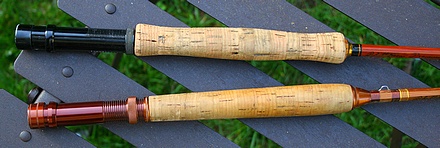
The top is an elliptical “hammer handle” grip on a Premium. The bottom is the “Torpedo” style. Note the highly functional lightweight metal reel seats.
Much has been written about the qualities of the Granger 8642 (an 8.5′ 5wt), yet little mention is made of the nearly identical Phillipson version of the rod.
Michael Sinclair – noted rod historian and author – once told me that when Bill Phillipson started the Phillipson rod company, he built his 8.5′ taper by retaining the best qualities of the Granger 8642, modifying the rod only slightly.
As a result, the 8.5′ Phillipson casts a DT5 line beautifully, yet fishes wonderfully even at close range.
In my opinion, the only rods that truly surpass it might be a few hollowbuilt numbers – rods far too labor-intensive for any production builder to make.
In addition to his “standard” 8.5 taper, Phillipson later introduced the “Dry Fly Special” – a faster taper that cast best with a 6wt and presaged the industry trend towards steeper rod tapers.
I’m not overly enamored of the Dry Fly Special (despite owning two of them), but admit that it’s an easier rod for most to cast, and its popularity can’t be denied. It’s an excellent windy day rod and like all Phillipsons, it’s bulletproof.
Other Phillipson Tapers
I own a 9′ Phillipson, and find it a useful rod on lakes, but it’s pushing the boundary of comfort over the course of a day. 9.5′ Phillipsons were also produced, but they’re relatively rare on the market, and a handful on the water.
Phillipson also produced a 4-pc Smuggler travel rod, a Haywood Zephyr, a handful of private label rods (for LL Bean, Abercrombie & Fitch, and others), and few odds and ends.
Still, fishermen will primarily be interested in Phillipson’s 7.5′ – 8.5′ rods.
The Fiberglass Era
By the early 1950s, fiberglass fly rods quickly grew to dominate the fly rod industry. Phillipson liked fiberglass for its low cost, ease of manufacturing, lighter weight and lower manufacturing costs, and wholeheartedly embraced the material.
Indeed, his glass rods are widely regarded as the finest of the era, with only a few custom builders challenging his superiority.
Phillipson invented the first pressurized curing system, where fiberglass blanks were cured in a pressurized bag – a technique that eliminated strength-sapping voids in the blank wall.
He also worked with fiberglass supplier 3M – the company that eventually bought the Phillipson Rod company – in the development of uni-directional fiberglass pre-peg for use in rods.
His Epoxite rods represented the height of glass rod production, and his Epoxite Registered Midge rods (6.5′ 4wt and 5wt rods that were ahead of their time) are rarely seen, and sell in the four-figure range.
Today’s Phillipsons
Phillipson’s bamboo rods haven’t enjoyed the demand from collectors other rods do – a fact appreciated by those of us who love them for their fishing qualities.
Indeed, while Granger prices grew to stratospheric levels, Phillipsons lagged, though in today’s vintage bamboo rod market, nothing comes cheap.
Less than ten years ago, a good condition 8.5′ Phillipson could be bought for as little as $250, and within the last ten years, I acquired a pair of great-condition 8′ Phillipsons for $350 apiece.
Bargains at twice the price.
Today, excellent+ condition 8′ Phillipsons are more often found in the $500-$900 range, with the 8.5′ rods a little less expensive.
Compared to Grangers and many of the more-hyped rods from eastern builders, they’re still an excellent deal.
Phillipson rods were never built for display under glass, and in today’s collector-oriented atmosphere, that’s a one-way trip to the “we’re not interested” zone.
That’s too bad for them, but good for those of us who simply like to fish the things – as Bill Phillipson clearly intended.
See you on the river (Phillipson in hand), Tom Chandler.
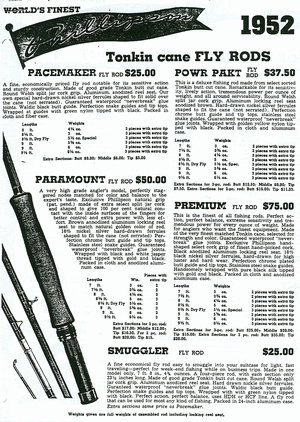
A 1952 Phillipson ad. By 1953, fiberglass rods reigned, and the bamboo was mostly impregnated rods. (click the image to see a larger version of the scan.)
[tags]fly fishing, bamboo fly rod, phillipson, phillipson fly rod, phillipson bamboo fly rod, fly rod[/tags]


Tom, all I can say is outstanding, I have all three now printed off, and will keep them to read over again. I am waiting for more history lessons of rod builders and tyers. I know you have ton’s of time to do the reserch. (yea right)
David
PS, just a few of the big bugs flying on Monday will drop down to the next run today and give you a report.
ran the upper run, a few smaller fish but one real nice Cutty.
Bamboo Addict(Quote)
Thanks for a great read. I’m fairly new to bamboo, and I fell in love with an 8.5′ Pacemaker I got to cast this past winter. I cast 10 or 12 different rods that day, and the Phillipson stood out so much that I know own it!
David Stankiewicz(Quote)
David S: Glad you liked the piece and the new rod. Phillipsons aren’t cheap anymore, but they’re still less expensive than most of the other vintage cane, and — adding Phillipson’s the more interesting stories about Phillipson (see Part II) to the mix — they’re a bargain.
Tom Chandler(Quote)
Tom, I really enjoyed all three articles. What a suprise for me to come across the history.
My father (deceased) had Phillipson build he and his father (also deceased) some fly rods. My dad’s was a Royal (7′-9″), and my grandfather’s was a Master (7’4″). Both rods have their names embossed by the Phillipson label. Such fun to have great history in the family.
Unfortunately, the Royal had an encounter with the garage door, and the cork handle and the very dip of the rod were broken. Is there anyone out there who can make some basic repairs?
Thanks,
TOdd
toddd gressett(Quote)
I didn’t go into the Phillipson glass rods overmuch, but they were widely regarded as being among the best of the time.
Owning your father’s rods is a very cool thing, especially since Phillipsons have such an interesting history to begin with.
One place has performed some repairs on Phillipsons in the past:
http://www.raptorrodworks.com/
Give ‘em a try. Good luck!
Tom Chandler(Quote)
I use to work over at Ricks Rods for a short time. I can tell you have done your research.
Now lets consider this question . What ever happened to the milling machine that Phillipson used? It was moved to Minnesota and I wonder what happened to it?
Bamboo Bill(Quote)
Ahh, the Phillipson milling machine. Like Amelia Earhart, it disappeared without a trace, and while people will say they saw Elvis using it in a remote Wyoming town, there seem to have been no credible eyewitness reports.
It’s one of the first questions I asked Mike sinclair when I had the chance, and I’ve seen it asked several times since online.
You’d have to assume the mill was shipped to Minnesota and probably junked (after all the bamboo rod market had all but disappeared at that point), though I’m willing to entertain credible alternative theories (Elvis building rods in Duluth, for example).
Tom Chandler(Quote)
I am fascinated by your three articles on Phillipson, While attending a fly fishing school taught by Henry Williamson (I betcha know him) I discovered that I have a Phillipson Paragon with the markings: Q8 9-5 5/8 HCH. I failed to take it to Henry, but he was ecstatic about Bill Phillipson when I called Henry on the phone. What can you tell me about it? I inherited the rod from my grandfather, James G. Johns of Birmingham. Granddad died in the early 1970s and had probably owned the rod for more than 20 years. All but one of the ferrules are golden and apparently original, That one was replaced (not overly artistically) and is reddish. Charlie Doster. (256) 237-2755.
Charles S. Doster(Quote)
Tom,
Pretty interesting series of articles on Phillipson and his rods. The first cane rod I ever fished was an 8.5′ Pacemaker and as luck would have it I caught a 19″ Deschutes redside on that rod and it became my rod for all seasons on the Deschutes. About two years ago I owned a very nice Payne 205, an extremely smooth 8.5′ 6wt. I was planning a trip to the Deschutes and some other Oregon streams and laid out some rods I was considering taking including the Payne and an 8.5 Powr Pakt. Since I didn’t want to take alot of rods with me I looked at the Payne and the Phillipson and asked myself, now which rod do you want to fish on the Deschutes? Without a second thought I picked up the Phillipson and sold the Payne when I got back from my trip. I think I made the right choice and my Phillipson’s are still my rod of choice as I now own an 7.5′ Peerless, 8′ Preferred, an 8.5′ Powr Pakt, an 8.5′ Dry Fly Special and a 9′ Paragon. I’m pretty much in agreement with you in that it’s the 8′ and 8.5′ rods that I like the best but then those lengths also best suit the streams I fish most often. I once owned 9.5′ Powr Pakt but after one hour on the Deschutes in a stiff wind I was beat. I will say that when it comes to 9′ cane rods the Phillipsons are head and shoulders above both Grangers and Heddons. In regard to the story about Phillipson’s dispute with the Granger business manager, Agnes Marshall, I think the rods marked 51 were meant to signify the 5 years in business. Both the Peerless and Preferred impregnated rods were first introduced in 1953 so it’s unlikely that the “5″ refers to that contentious relationship and the dire prediction of Agnes the Witch. According to Colorado Classic Cane, Ann Smith who did all the lettering on Phillipson rods from 1949 to 1972 did not recall the meaning of the “5″ designation.
My friend, AJ Thramer has always been inspired by the work of Bill Phillipson in producing high quality rods at a more affordable price and his new Western Trout rods are directly inspired by Phillipson rods.
greg hall(Quote)
Great article!!
i sold David the Pacemaker, kiscked myself for several months as I had a hole in my fishing arsenal. Just picked up a 8.5′ Paragon to fill the void – Dave you got the nicer rod :)
Enjoy – Pete
Pete Van Schaack(Quote)
Hey! Great article and am I glad I found it! I have a Phillipson P86F Rod that I bought at a yard sale about 15 years ago…..I am looking to sell it and am looking for a reasonable price to post it at. It is 104″ from tip to butt and is three piece, in very good condition….even has a green canvas 3 slot pouch that it came in. Any advice out there?
Thanks..
Michael Lindsey(Quote)
I send people to Ricks Rods in Denver for Phillipson…..I have no business connection with Ricks Rods but…they do good work and have a great selection of thread for the rods….
Bamboo Bill(Quote)
Michel: That’s an 8.5′ rod, so it should be 102″ when assembled. That’s also a glass rod, and failing more information, I can’t give you much of an idea.
A good place for information (and to sell the thing) might be the Fiberglass fly rod board:
http://p099.ezboard.com/bfiberglassflyrodders?
Good luck! The Phillipsons glass rods are gaining a little momentum on the pricing front.
Tom Chandler(Quote)
Thanks for the information Tom. When I bought the rod there was also a 6-sided bamboo rod, actually several pieces (3 end sections anyway),however, I don’t see any manufacturer logo on the rod….I “think” it might be a phillipson also, since it was all together?? I also got a oren-o-matic reel that is in real good shape, model 1140D. I think I will take it all by Ricks Rods here in Denver and see what they have to say.
Michael Lindsey(Quote)
The bamboo rod could be almost anything. If you could take some pictures of the reel seat and grip, then maybe we could determine something, but as it is, we don’t have much to go on.
Good luck at Ricks.
Tom Chandler(Quote)
I have a 8.5 foot varnished Pacemaker with a hammer grip. Rod is in a fiber tube and green canvas rod sack. Tube cap is a painted gray. On the cap’s inside you can see a partial Beech Nut logo (as in smokeless tobacco). My question is whether/why/when Phillipson produced Pacemakers with a hammer grip. No other markings on the rod. Rod, marking and grip all look original. I’ve owned the rod since ’92. And, it’s fun owning something from a good outfit like Phillipson. Enjoyed the articles. Thks, Warren in StL
Warren Grace(Quote)
Warren: I have two Premiums with the hammer grip, and despite its somewhat small size, it absolutely disappears in the hand. Great stuff.
As for why it’s on a Pacemaker, keep in mind that the “production” shops of yesteryear aren’t quite as rigid as today’s fly rod production lines, and apparently it was fairly common for Phillipson and Granger to custom produce a rod now and then for a good customer.
At least that’s one possible explanation.
Tom Chandler(Quote)
Tom,
That was the most comprehensive article I’ve seen regarding Ted and his rods. I really enjoyed it. Tom I have a 9’1/2 6 1/4 HCH Paramount 51 Hammer Handle. Do I use 6 or 7 wt. line on it today. Or could I use a DT HCH Orvis Oiled Silk fly line that I also have on it?
Dennis Belville(Quote)
Dennis: I’ve never even held a 9.5′ Phillipson, which isn’t all that common a rod.
I would say fish whichever line feels best — the translation from silk to modern lines has been somewhat inexact, and the bamboo rods can typically handle a pretty wide range anyway.
That Orvis silk line sounds pretty good — especially given that the most high-tech of modern fly lines (SA’s Sharkskin) is well on its way to imitating the textured finish of silk… 8-)
Tom Chandler(Quote)
Want a Phillipson bargain? Keep on the prowl for Fred DeBell’s bamboo rods that were assembled with Phillipson blanks and ferrules.
5X(Quote)
Thanks so much for this article! I’ve been wondering about my rod for a while. I own a Phillipson Pacemaker “51″ 8 1/2-5 HDH with a hammer handle and green anodized seat which I acquired at an auction for $10. I love fishing with this rod. I’ve got both tips, the bag, tube and reel. I usually use the one that came with the rod. It’s stamped “Made in U.S.A.”, black paint, white plastic (maybe ceramic?) handle, drag set. it’s pretty beat up and I’m thinking about replacing it. Any info on reels for this rod or my original reel?
Susan Turnquist(Quote)
Susan: $10? You got a deal. I can’t identify the reel from your description; if you send a picture, I might be able to help.
As for modern reels, I’m not really a stickler for period reels on bamboo rods. If you are, then an earlier, American-made Medalist reel is a good choice, as is the more-expensive Hardy Princess.
There are a bazillion modern reels that would work well on that rod, and it’s really a matter of preference.
Tom Chandler(Quote)
Terrific set of articles. I just encountered a Phillipson Paragon (8″, three pieces, two tips) at a local second hand store. The one tip was missing a ferrule. It was in servicable shape and am considering buying it for the equivalent of two tanks of gasoline. How difficult is it to replace said ferrule and, as the local waters contain notable smallmouth and crappie, do you think it would be a good choice? Thanks.
Samuel Pichardo(Quote)
Yes, it’s a good choice and the price range you mentioned makes it very attractive.
Replacing the ferrule isn’t difficult, though if you don’t have experience, consider sending it to a pro builder for repair.
It will be a great rod for small crappie flies and smaller poppers normally used for smallmouth, though when it comes to the really big, non-aerodynamic bass bugs, a 5wt is a little on the light side.
Do it!
Tom Chandler(Quote)
Thanks for your research. I inherited a 9.5′ from my Grandfather – brand new in a metal tube. I must have used it for 5 years before I finally lost my nerve and retired it. It is SO amazing. I’m afraid of busting a tip even though there is a spare. It’s great to hear about the background – something now to print off and keep with the rod that reminds me of my grandfather and the rest of the Curt Gowdy and Sam Mavrakis Sr. generation from Wy.
Jim Davis(Quote)
Jim: Very cool. The 9.5′ Phillipson seem fairly rare, though they’re probably not worth a lot given the weight. What model is it?
Tom Chandler(Quote)
Tom: Thanks so much for this great article. Because of it, I just acquired an 8.5 Pacemaker. The rod is varnished with a black tenite seat. The handle is a full wells without a thumb indent. It is as new with no sign of ever being used. I can’t wait to begin a relationship with it.
Tim Cottage(Quote)
Tim: Let us know how you like it. The 8.5′ Phillipsons aren’t for everyone, but if they fit your style, they’re amazing rods. Fish one during a #22 BWO hatch, and enjoy the ride.
Tom Chandler(Quote)
Great information! I was especially intrigued by your comments on the private label rods. I inherited an Abercrombie and Fitch Smuggler 3 in 1 rod that I am having trouble getting information on. Could this be a re-labeled Phillipson Smuggler? Any help is appreciated.
Craig Lockwood(Quote)
in reading about phllipson rods, it brought back a time when phillipson sold to wright & mc gill. During ww11 i worked for a tent and awing co in greeley co. the owner had started to sell sporting goods during the great depresion and he carried both the granger and phillipson line. at twelve years of age i purchaced a phillipson 8.5 phillipson rod and still have it. it does not have a locking reel seat but I still use it when i go fishing on the north platte river at saratoga wy. I rember the first large trout, german brown 9lb 3 oz. i caught using a potts hair fly, sandy mite. It took 1 hr 7 min to land that fish, when i released him i was worn out as was wiley brown, what a thrill. I still have that rod and will never sell it, it goes to my grand son.
john(Quote)
John: Phillipson didn’t start the Phillipson Rod Company until after WWII, so yours – without the locking reel seat – sounds like it could have been made early in the Phillipson Rod Company’s history (or it’s a custom number, which isn’t that uncommon).
Cool stuff.
Tom Chandler(Quote)
Tom,
I enjoyed reading your articles on the history of the Phillipson flyrods. I own a Phillipson PowrPakt that I purchased about 15 years ago. The rod is in very good to excellent condition. It is a three section rod with two tips. I brought it to an Orvis dealer friend of mine who was the grandson of the founder of the Shakespeare company in Kalamazoo, Michigan for an appraisal. He described the rod as very good to excellent with some discoloration of the handle (hammer style) and only one minor varnish chip on the middle section of the rod.
The only marking for weight and length of the rod are two figure 8′s on the opposite of the rods’ Phillipson PowrPakt script. Can I assume this means an 8′ 8wt.? I’ve never fished the rod, primarily because of not knowing the actual age and being a bit protective of the rod.
Also, from reading your article, these apparently have come up in cost as collectibles. What is your guess on the approximate value?
Again, thanks for your very thorough research and I would appreciate your input to my query.
Regard,
David Priest
David Priest(Quote)
David: I don’t believe Phillipson made an 8′ 8wt bamboo rod, and without a clear picture of the markings, I can’t be sure about the length or weight of your rod (Phillipson cane rods often contained a “weight”marking that referred to the blank’s weight).
Without more information, I can’t begin to speculate as to price.
Tom Chandler(Quote)
Tom,
Thank you for the response to my inquery. I have taken pictures of the markings as well as measurements of the rod. Would it be an imposition by me to request your e-mail address so I can email you these photos and measurements? My email address is:
david_a_priest@yahoo.com
Thanks again for your help.
Dave
David Priest(Quote)
Tom,
Thanks for the articles and info.. I would like to identify a Sports Castle “St. Regis” 8 1/2′ Line #6 or 7 (3 pc) bamboo fly rod in script which looks a lot like the Phillipson script on rods pictured. It most likely had a 2nd tip but I only have one. Also the stripping guide which I believe to be original is very small diameter like ones used for silk fly line. I believe it may be made by Fred DeBell and has many of the characteristics of Phillipson rods, blanks, ferrules, etc. It is heavier than most Phillipsons I have owned or read about. What can anyone tell me about it? It has yellow (gold) wraps with blood red tipping. The reel seat is downlocking, silver at the top and the spacer is black aluminum. Tight Lines, Steve
Steve Hall(Quote)
Great artcile!!! I just acquired a Pacemaker 8′ – Do you know the signifigance of these markings:
http://viewmorepics.myspace.com/index.cfm?fuseaction=user.editAlbumPhoto&albumID=790774&imageID=45919033&MyToken=f1d4cfa8-4f24-4017-a8a2-9bdc40499bac
It looks like a tiny a7.
Benjamin Broadwater(Quote)
Oops – try this link instead . . .
http://viewmorepics.myspace.com/index.cfm?fuseaction=viewImage&friendID=56924803&albumID=790774&imageID=45919033#
Thanks : )
Benjamin Broadwater(Quote)
TOM I HAVE PHILLIPSON CHALLENGER FLY ROD IT IS 102 INCH LONG ,I KNOW NOTHING ABOUT WHAT TYPE OF FISH TO FISH FOR WITH THIS ROD OR WHAT TYPE OF LINE TO USE. AFTER READING YOUR ARTICALS I AM EXCITED TO TRY THIS POLE OUT
DICK NELIGH(Quote)
@Benjamin: I’ve heard conflicting stories, but those numbers are often attributed to the person inspecting or wrapping the rod. In this case, the proximity to the wrap suggests the rod may have been refinished.
@Dick: I believe the Challenger is a fiberglass rod. Phillipson made fine glass rods, though they weren’t the subject of these articles.
Tom Chandler(Quote)
Thanks much Tom – you are correct about the refinish. While we’re on the subject, I’ve never seen another Paramount for comparison – do you know if what appears to be clear intermediates ( visible between the ferrules and guides) in this pic are original?
Thanks again,
BB.
http://viewmorepics.myspace.com/index.cfm?fuseaction=viewImage&friendID=56924803&albumID=790774&imageID=46010441
Benjamin Broadwater(Quote)
No, I’ve never seen intermediates on a Phillipson. I doubt Bill Phillipson – who wanted to make great fly rods that didn’t cost a lot – would think much of the idea. It’s hard to tell from your picture, but I’m not sure if those ferrules look very original. You really have to be careful when you buy a “refinished” bamboo rod (ask me how I know). They can have lots of weird parts stuck together (I bought one with tips that had probably been cut down from a 9′ rod).
Tom Chandler(Quote)
Hi Tom,
Very nice article,
I recently inherited a Phillipson Power Pakt. The only other identifying mark on the rod is the #78 on the opposite side. It is what I believe to be a 3-piece 8′ rod with extra tip. Each section measures 32.5″ from tip to butt. It seems to be all original and in good shape with some minor scuffs. The reel seat is most likely bakelite with what seems to be aluminum down locking components.
The ferrules need some cleaning and never owning a bamboo rod before I was hoping you could give me some tips on cleaning so I don’t damage the rod.
Also, if you could give me a general Idea of value I would appreciate it.
Thank you,
Mike
Mike Coons(Quote)
Sorry Tom,
I forgot to ask if you know what the #78 stands for. Could this be an 8′ 7 wieght or is it the 78th rod built? If so, how do I find out what wieght it is?
Thanks,
Mike
Mike Coons(Quote)
Tom
I have never been much of a fisherman, but enjoyed your writeup while researching about a rod I just came into possession of. It is a Pacemaker 8′ 4 1/2″ HDH, 3 section with extra tip, hammer handle, green aluminum reel base, 4 slot canvas bag, fiber tube with gray metal cap and the Philipson Pacemaker Rods label on it. It appears to be varnished (my guess) and looks almost unused. There are no signs that a reel has ever been put on it. I was wondering, what does the “HDH” stand for and what do you think it might be worth?
Doug E.(Quote)
Most of the 8′ Phillipsons cast a DT5 nicely, so try it with a 5 and 6 and see what you think.
As for value, if you’re interested in sending it to a certain fly fishing blogger as thanks for a job well done, I’d suggest it’s worth about $27.25, though in a grand gesture, I’d also pay shipping.
If you’re interested in selling it to a Phillipson fan, the price can vary widely, but perhaps $400-$800 is a good range (the high end probably won’t be reached by a Pacemaker, but you never know).
Good luck!
Tom Chandler(Quote)
If memory serves an HDH is a modern day AFTMA #6.
“HDH” used to standard for the taper diameters, H = 0.25, D = 0.45 … but manufacturers started playing games with the letter-diameter nomenclature – so the American Fly Tackle Manufacturing Association developed the current number standard.
Now the manufacturers are at it again…
More information on the old line standards and measurement can be found here.
http://books.google.com/books?id=Cc6bHeUtMxwC&pg=PA38&lpg=PA38&dq=HDH+line+size&source=bl&ots=-FPcVrxf2H&sig=_Zo57JgNiXyPtJpfs-vdpRzVLaA#PPA37,M1
kbarton10(Quote)
Tom & kbarton10:
Thanks for your input! The information is greatly appreciated. I am guessing that this rod was made between 1945 and 1961 (the change of the line rating standard). It will be interesting to see what it fetches.
Thanks again!
Doug E.(Quote)
Almost certainly made before 1952, and remember – $27.25 and you don’t have to bother with all that messy online selling stuff. No need to thank me.
Tom Chandler(Quote)
The Phillipson Smuggler was a 7′ 8″ four piece one tip bamboo fly rod rated for a 5 or 6 wt. line.
The so called hammer (or elliptical) handle was limited to the Paramount and Premium grade rods though no doubt could have been special ordered on other grades. This handle looks similar to the common full wells grip but differs in that the profile in cross section is egg shaped rather than round like the full wells grip. A similar grip was used on some of the shorter Granger rods though I think it was more of a flattened full wells rather than the egg shape of the Phillipson grip.
The age of a Phillipson Pacemaker can be narrowed down by the color of the guide wraps. From 1946 to 1951 the wraps were green nylon with yellow tipping. In 1952 the wrap colors changed to olive green tipped black. I think that by 1953 or 1954 the varnished rods had pretty much disappeared, at least from the Phillipson catalogs.
greg hall(Quote)
I have found a phillipson pacemaker but it is not a fly rod. it appears to me to be a spinning rod. I say that because the reel mount is not on the end it is in the middle of the handle. It has on it “7-43/4″ and the number 80. I havn’t been able to find any information on this rod. could anyone help me out?
David(Quote)
David,
I found this info in Colorado Classic Cane. The Pacemaker Spinning rods look to have been introduced in 1949. They were 7′ 2 piece rods weighing 4 3/4 oz. and sold for $22.50. I haven’t found much more definite information but they were probably replaced in the mid fifties by fiberglass spinning rods.
greg hall(Quote)
I once bought a Phillipson spinning rod from one of the “name” fly rod dealers, though because it had been poorly refinished as a fly rod, it wasn’t clear to me (until I cast it).
It was the same length as described, it made a horrible fly rod, and I don’t have much of a hand on the value of the things.
Tom Chandler(Quote)
Greetings. Trying to figure out this old Phillipson. The aluminum tube states “Phillipson P64S Spin Rod” but you can mount a reel in either of two places. Am I correct in my assumption that this is a “Combination” rod? Is this model bamboo or is it fiberglass? And the enevitible is it worth anything? I’m staging a tag sale next week for the benifit of the son of a recently departed friend and don’t want to undersell (grossly) the item. Hope to hear from you but understand if you find it a bother. Thanks. regards, s.o’n
Stephen O’Neil(Quote)
i just found in an old friends shop a phillipson paragon,39 9-5 5/8 HCH.this is a three pice in a vinyl over cloth case,all in good condition. could you give me an appoximate value . thanks butch
butch murdock(Quote)
8-12-’09
Cadiz, Ohio
I have a 9′ or 91/2′ Phillipson Paramount, 4 piece, flyrod with original cloth sleeve and aluminum case. This was pruchased new in Port Angeles, Washington in 1958 when participating in the Student Conservation group as a graduate student. This rod has been used c. only three or four times and stored since ’58-’59. Ohio is not fly fishing country!
I would be interested in selling it to someone who would use and appreciate it for a reasonable price. If interested e-mail me at–cado43@gmail.com or call 1-740-942-2401
Thomas R. Ford(Quote)
I have a Phillipson Premium 7.5 ft with the letters HEH on the butt section. Does this refer to the line weight to use and what might that be, perhaps a 5 wt. It is a 3 3/4 oz rod in perfect condition. Thanks so much for any information.
Grant Somers(Quote)
I’ve answered most of the above comments via email.
It’s probably going to take a 5wt. I had a 7.5′ Phillipson Premium and found it to be a pretty strong 5wt.
Tom Chandler(Quote)
We just recieved my great grandpa’s 9’5” 5/8, it was used maybe 5 times if that. We were just curious on the value of that rod.
Trisha Lloyd(Quote)
There was no 9′ 5″ Phillipson rods (that I know of). It’s probably a 9′ (5 5/8oz), and value on the 9′ Phillipsons wasn’t great – probably less than $450. The bamboo market has definitely come down some lately, so may be a couple hundred less…
Tom Chandler(Quote)
I think the 9′ Phillipsons are currently worth around $250 or so depending on condition and model. When the economy started to crash in summer 08, the used bamboo rod market really took a hit. It seems to be coming back now, but it will slow down again until early Feb due to the holidays (always does). If you’re planning on selling that rod, I’d wait until Feb and put it up for sale then.
Brian
Heddon17(Quote)
I always cringe when people ask me to offer estimates of value. At the height of the madness, I saw 8.5′ Phillipsons listed at near $1K by the big rod dealers, which seems pretty ridiculously high.
I love Phillipsons, but wouldn’t spend a lot on a 9′ rod until I’d fished one – you might discover you simply don’t like them.
Tom Chandler(Quote)
Fishing with Great-Grandpa’s Phillipson – priceless…
Susan(Quote)
Greetings Tom- I recently purchased an 8 ft Phillipson Pacemaker. Being a newcomer to bamboo I have two questions for you:
1. Rod is flawless, except for a very small chip out of the varnish on the butt section (roughly 2 mm). Should I varnish over this, or can rod be fished as is?
2. The only inscriptions on the butt section are “Phillipson Pacemaker” and a small number “68.” No rod length, weight, or line size. These are all listed on the paper label on the original tube. Was this the norm for early model Pacemakers? Thanks.
Blain(Quote)
I keep a small vial of a fast-drying, water-based “varnish” handy to repair just such chips (Gudebrod’s rod varnish is good for this, though not much else). In your case, repair may not be critical, but remember that water isn’t exactly a bamboo fly rod’s friend, so keeping the varnish intact is a good thing.
The trick is to apply a tiny bit, and to not muck up the finish around it. I used a toothpick.
Good luck! It’s a wonderful rod.
Tom Chandler(Quote)
I recently came into possession of a Phillipson Pacemaker fly Rod HDH Line ,8 1/2 ft. , 5oz, with two tips and the Premium elliptical “hammer handle” which I plan to fish as soon as possible. There is the number 48 painted on the butt section just forwrd of the handle. What is the significance of this number?
John M. Colligas(Quote)
I never have received a cogent explanation about the number. Michael Sinclair (who would know about as well as anyone) suggested it was a code on the rod identifying a builder or inspector or other employee.
It’s tempting to think it’s the year it was built, but the numbers don’t always make sense that way.
Does this rod have “Dry Fly Special” written anywhere?
Tom Chandler(Quote)
If you look closely at the catalog page posted above you will see that the Dry Fly Specials are listed at 5 1/2 ounces and would be marked as such. The Dry Fly Special rods were introduced in 1952 which is the same year that the wrap colors on the Pacemakers were changed olive green tipped black. So a Pacemaker Dry Fly Special would have olive green tipped black wraps. The wrap colors are also noted on the above catalog page.
greg hall(Quote)
I own 2 Phillipson rods and a old Wright& McGill 3 peice,Granger Special. The Phillipson rods are both 7 and half ft. one a premium with the hammer handle and the other a peerless impregnated5 withthe torpedo handle, both of them with 2 tips. I love the feel just like my dad did.
Stuart Oldham(Quote)
Hi Tom – I just purchased a 8.5 3pc 5wt Phillipson EMHunter Approved rod and am awaiting its arrival. I really enjoyed reading your bury me series. Can you tell me anything about its history and what I can expect for casting etc…? Thanks! -Mike Gundel, Registered Maine Guide
michael gundel(Quote)
Having owned three Grangers and one Phillipson, I can’t see any significant diference between the two brands when compared to wgts. and lengths. Currently the only
significant difference seems to be Grangers are for collectors and Phillipsons are for collector-users. I grew up in New england and only knew fly fishing not as a snobbish sport, but as an enjoyable practicality. Now living in Applachia among the spoils of the coal industry I will have to relinquish my faithful Phillipson Paramount, in pristine condition, to one who appreciates a great rod at a reasonable price. Any good offers?
T. Ford
Tom Ford(Quote)
Hi Tom,
What is the length of your Paramount?
Thanks,
Shawn.
(801) 350-1548
bennystaff@yahoo.com
shawn(Quote)
Looking for some info. I have my uncles Phillipson pacemaker “51″, 9-5 5/8 HCH. Still hase the wrapping on the cork handle. The rod MIGHT have been used once or twice. Still has canvas and hard tube too. Dont know if I should use it or just look at it. What would the correct reel be for this rod anyway? Any info you could pass down would be great.
Thanks
Rick
Rick(Quote)
May 8, 2010
I still have the Philllipson Paramount, 9ft., for sale. It is in almost pristine condition having been use only three or four times . I would ask only the reasonable going price — usually ebay, whatever that may be. Reason for selling — age and Ohio is not for fly fishing.
T.R. Ford, Cadiz, Ohio, 1-740-942-2401. My e-mail would be the preferred contact.
Thomas R. Ford(Quote)
Not trying to sell, been in the familly to long….just looking for some info on it…maybe when it was bought…uncle served on PT=109….just wondering.
Rick(Quote)
Almost certainly made between end of the war and 1950.
You can use it, though most folks find the 9′ bamboo rods a little heavy.
Tom Chandler(Quote)
The 9′ bamboo rods are pretty subjective. Some really like them, others can’t stand them. This even applies to rods made from one maker to the next. For example I have a 9′ Phillipson Powr Pakt and really like that rod. I also had a 9′ 2 1/2 F Heddon #14 for a while but ended up selling it since that rod just didn’t do it for me. Other folks really like the 9′ 2 1/2 F heddons. On the other hand I have 3 of the 9′ 2f heddons and those rods I really dig. I like those rods even more than the Granger 9050.
I also had a 9′ 346 South Bend and a 9′ Weber and sold both rods shortly after buying them since I just didn’t like either one.
Brian
Brian Thomas(Quote)
I found a Phillipson Premium 8 ‘ 4 1/4 HDH . Looks new still
in cloth case and aluminum tube. Curious about age and value.
Jack Angstadt(Quote)
Jack; Must have missed your comment. Like all the non-impregnated bamboo Phillipsons, it’s almost certainly made from 1946-1952. I’ve given up offering price quotes on this blog since one man’s $350 rod is another’s $1,000.
Tom Chandler(Quote)
Been fishing Bamboo for about three years and have picked up a few WM Grangers and Phillipsons along the way. My favorites so far are the 8′ Phillipsons (I haven’t yet been able to acquire a Granger 8040). I have two 8′ 4 1/4oz. Pacemakers and one Powrpakt. The actions on these are very similar from rod to rod. I just recently found a 8′ 4 1/4oz. Premium which has a noticeably faster action than the other rods. The Premium’s flex is focused very near the tip-mid ferrule, while the others seem to flex closer to the middle of the rod.
Has any else experienced such variations from rod to rod? Is the variation more related to the different grade, or possibly date of manufacture?
The premium is marked 4 1/4 oz HDH, while the others aren’t marked at all. All the ads I could find (ie. CO Classic Cane) specify all the 8′ varnished models at 4 1/4 oz.
Appreciate your thoughts on this.
shawn stafford(Quote)
My 8′ Premium offers a faster taper but a lighter tip than my 8′ impregnated Phillipsons, but as to why that rod is different from your other varnished Phillipsons I can’t say for sure.
The Premiums got the best cane and perhaps that’s a factor. I have no information about a change in the taper itself, but I will say it wouldn’t be unusual for a rodmaker to alter a taper or perhaps even create a more “custom” version of a rod for a good customer.
Unlike today’s mass-produced rods, bamboo is never really consistent.
Tom Chandler(Quote)
My dad was buddies with Bill Phillipson, as my dad’s garage was only a couple blocks from Phillipson’s shop. I have a custom Phillipson pole that my dad ordered for me as a child, so it’s shorter than an adult pole, and it has my name engraved on it. We also have a whole bunch of other Phillipson poles, not really sure if they’re casting or fly rods. I was using a Phillipson Royal this weekend up at Sweetwater and caught a bunch of beautiful trout, but my friend thought maybe I should think twice about using that pole! Where would I be able to find out if these are worth more to enshrine or should I just continue to use them?
Christine Krueger(Quote)
It’s hard to tell from your post. Up until a few years ago, some Phillipson bait casting rods fetched astounding sums from overseas collectors. The spinning rods aren’t usually that valuable, though many of the fly rods are worth a fair chunk, though the “standard” fiberglass models aren’t wildly expensive.
Some phillipson glass fly rods might be worth less than $100; lay your hands on an epoxite registered midge rod and you’ve got something worth well over $500. Bamboo fly rods are worth quite a bit more.
I can’t tell you much more; consider getting an appraisal from someone (you’ll need to get the rods to them or get pictures), but you’re potentially sitting on a fair chunk of change…
Tom Chandler(Quote)
I have (3) Phillipson Peerless bamboo rods that have never been fished and (14)
Phillipson/3M epoxite rods that are in reasonably good condition. Also have the
SA/Hardy reels that match up with these rods. Is there a forum for collectors that
might be interested in any or all of this equipment? Just fishing.
Daniel L Jewett(Quote)
It sounds like you missed the subsuquent post about the Phillipsons; turns out the EPA determined that a chemical used in the impregnated Phillipsons and late-model glass rods (like the Epoxites) was so toxic that the rods aren’t supposed to be used or even touched for fear of immediate contamination, followed by a long, painful, lingering death.
Things are grim enough that only two dump sites hold high enough hazard ratings for safe disposal, and the first is closing, leaving only the western installation (somewhere near the Northern California border).
I can give you
mythe hazardous waste dump address if you email me.If you insist on endangering yourself and loved ones, the Classic Bamboo Fly Rod Forum would help with the bamboo (though many of them are not as enamored of the impregnated Phillipsons as I am).
You can find out more about the Epoxites at the Fiberglass Fly Rod Forum.
Tom Chandler(Quote)
– just found an old article in the Yankee Magazine about the difficulty of fishing the Battenkill, by Tappley. I was astounded that he used a nine foot fly rod, of unmentioned make. Isn’t this unusual?
Thomas R. Ford(Quote)
9′ rods are the “standard” in fly fishing, and were common even in the days of bamboo. I’d suggest the average rod length back then was shorter, but 9′ was still a common length.
Tom Chandler(Quote)
Hi Tom,
Great reading in this forum. I own a Phillipson “The Scout” TS 90, 9′ 2 piece with HCH line weight.(which equals what?) It has a red anodized reel seat and guides wrapped with a medium blue silk.
With everything that I have read I have yet to see anything on The Scout model. It appears to be be a varnished finish on the round rod.
Any information you may have would be greatly appreciated. Also a ball park value because of my fear of fishing this rod and not wanting to destroy it in any way.
So far the rod is absolutely great to cast!
Thanks very much! Jerry DeGroat
Jerry DeGroat(Quote)
If it’s round, it’s a Phillipson fiberglass rod. Feel free to fish it, though if it has metal ferrules, be aware of any “clunking” sensation when you cast the thing – the ferrule glue may have loosened.
I’m not really current on the value of Phillipson glass rods; Google the Fiberglass Fly Rod forum and check there.
Tom Chandler(Quote)
Jerry,
An HCH line loosely translates to an AFTMA #7
A conversion chart for old lines exists here.
http://www.herndonrods.com/choosing_a_silk_and_synthetic_fly_line.htm
kbarton10(Quote)
I have a Phillipson rod made of fiberglass , you can mount a reel in two positions.
The markings on the rod are P7D5L 1/4 oz. what can you tell me about it?
Jeff Parkinson(Quote)
Hi Tom, I’ve really enjoyed your site, which I found some time ago searching for information on Phillipson rods. I have a rod marked Phillipson Premium “51″, Dry Fly Special, 81/2 – 51/2 HDH. It matches the description in the 52′ catalog page posted in this article. I read that this was he marked al the rods made in 1951 for his 5 year anniversary but also read that there is no discernible pattern to the numbers and that perhaps they were inspectors or the like? Can you shed any more light on this? Also, do you know what the HDH stands for?
This rod was handed down to me and I wasn’t sure if I should fish it or not but after reading your article, I realized it would be a shame not to get it on the water. Thanks!
Matt
Matthew Clark(Quote)
“HDH” is the old line rating system, and while it’s not exact, it roughly corresponds to a modern 6wt double-taper.
Which is what I throw on the Dry Fly Specials, though I admit to finding them a little to stiff to wholly fall in love with them.
Tom Chandler(Quote)
Thanks for this series, it is very informative.
I own an 8.5′ Ed Hunter Approved, built by Phillipson, with 17 and 11 ferrules. This rod is a solid 6 weight, an opinion echoed by Ernest Schwiebert in “Trout”. I am interested in acquiring another 8.5′ Phillipson, but the seller states this rod is marked as a 5 and is a solid 5 weight. Other than the DFS, were there variations in the 8.5′ taper that would make one a 6 wt and one a 5 wt?
tom kolthoff(Quote)
I’ve heard some describe the “standard” 8.5′ Phillipson as a 6wt, but my guess is your Hunter is a Phillipson Dry Fly Special — a stronger, faster version of the “standard” 8.5′ Phillipson that was pretty clearly a 6wt (I’ve forgotten the ferrule measurements for each).
It’s a very useful rod, though I find it a hair stiff and don’t like it as much as the standard rod.
Tom Chandler(Quote)
Hey thanks for the interesting site… I have a 9′ 5 5/8 HCH Pacemaker!!!!!With 2 tips and the fabric and metal container!!Bamboo Anyone interested can e-mail me!!Thanks for the info!!
Vince Sparr(Quote)
Tom, I enjoyed reading your articles on the history of Phillipson, I am a novice collector/restorer of vintage bamboo fly rods, I have amassed a fair collection, first having a quest to acquire the best examples of the major makers and then find my niche with a specific makers work. As you know the quest for a good rods often means looking for bargains with often comes with parts rods as part of the main sell. Well I am not a glass rod collector as such, but have a few Heddon glass rods to harvest parts for the bamboo Heddons on occasion. I recently purchased a 7’6″ 2/2 bamboo rod and along with it was a Phillipson S86 through in as part of the deal. I know nothing about this rod, nothing is written and I found the Wiki site lacking on details as it is coming up to speed. After logging the rod I found the tip is down about 10″ making the rod 7’7″ otherwise complete and fishable. My question is I believe this was a 8’6″ rod originally and not knowing if it was a 2/2 or 2/1 or what the tube and bag looks like, to make it complete I would have to acquire a new tip and the tube and bag. What did they look like and where would I find that information to make this a complete set as original?
Thank you for your efforts.
Ed Ponder(Quote)
Hey Tom:
I’m looking at pictures of an 8.5′ Pacemaker 3/2 described as being” in storage for the last 15 years and in excellent condition, probably unfished”, although the cork is uncovered. The pictures, however, show the ferrules are black as are the guides and the wrappings are in what looks like a solid brown. I thought the wrappings were either supposed to be green tinged in yellow or black. The reel seat is black. Unless this rod was refinished can you tell me whether either Phillipson or 3M ever changed the wrapping color? Who would bother to refinish the rod and not use the correct color nylon thread? It doesn’t make sense. Though the rod looks good in pictures, should I stay away from it?
Bill(Quote)
I fish with an 8 1/2 DT 6 Wt Pacemaker on rivers here in the Rocky Mountains – love the slow action. Would never give up this rod. Somehow it just feels right to fish with wood. Thanks for all the info on Phillipson rods.
Dan Moschet(Quote)
That’s a great rod. Fished the heck out of mine, though with a DT 5…
Tom Chandler(Quote)
Been fishing it for years with a DT 6 – no wonder its so slow ! Love it like that though!
Dan Moschet(Quote)
I just bought a vintage Phillipson “The Scout TS 70″ and it is in great shape with nothing broken or marred and I was wondering what the approximate value might be. I have no idea of its actual age but the rod itself is a dark red/maroon with blue/green wrapping on the eyelets. Please help.
Chad(Quote)
I have a phillipson smuggler in excellent condition except it is missing the tip. Any ideas on how to get a replacement tip.
Robert fransen(Quote)
Hi Tom,
What a great site for Phillipson info! I recently ran across a 8’6″ Paragon with silver anodized seat and plain goldish green wraps, no tip colors, in new condition in a cardboard tube. It is strung up with a dt6 line and I am addicted. I also just found a Powr Pakt 9’6″ for an HCH line. I occasionally use some heavier nymphs and fish them shortline style. I also figure chucking hex pattern dries might benefit from this thing. It has a satin finish on it with a hammer handle on it using a gold anodized seat with brown plastic spacer. How can I date these things?
_Mike
Michael Knepp(Quote)
I recently bought a Phillipson 9 1/2 ‘ Powr Pakt in nice original shape. Both tips straight and full length, good finish overall, nice reel seat with the hammer handle which is a little weird but kind of like the details on other stuff from the fifties. I took it out and cast the thing with a DT7
Cortland 444 Sylk and found it to do quite well. It is a slow but efficient action that definitely puts your flies out in public view. I found a loose ferrule on the top of the second section which did not rock but wants to pull off. What kind of glue was used and what was the gold yellow thread on the Powr Pakt model? I’m guessing it’s a nylon and not a silk thread. Please help!
-Mike
Michael Knepp(Quote)
The Phillipsons are now in the neighborhood of 60 years old, so the glue on the ferrules is starting to give up the ghost.
Michael Sinclair suggested those little sticks of hot melt glue (he mentioned the fishing specific ones you buy from rod building supply stores) were a good replacement when the Phillipsons gave up the ghost.
As for the thread, I’d have to dig into my old books to get a sense of the color of thread used on the Power-Pakt, though what’s also true is that after all these years, the thread on the rod has probably faded/changed color due to exposure to sunlight, so even the “original” thread wouldn’t look right.
Michael Sinclair’s Bamboo Rod Restoration Handbook only says the Power-Pakt wraps were yellow nylon, though later it lists the Gudebrod color number as 6778. Unfortunately, I believe Gudebrod went out of business, but at least this is a start.
Tom Chandler(Quote)
