The Trout Underground isn’t exactly awash in “how-to” information, but every once in a while I get all helpful and nice, and something useful gets put on paper. This is one of those moments.
Because I’m going to reveal one of my Secret Fall Patterns.
Bees. Those buzzy, stingy things.
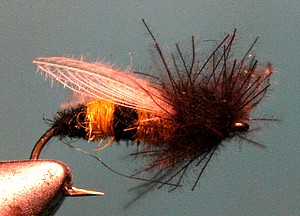
Fishing in the Fall? Dieing bees might be your best “hatch”…
Once the cold weather sets in, the bees start dieing. The male honeybee drones die off after being evicted from the hive and worker bees also succumb to the weather – as do a lot of wasps and and the like, the communities of which typically disband in the fall.
The die-off begins first on the high alpine lakes, and as the cold temperatures work their way downhill, the die-off follows.
I’ve hit the “bee hatch” several times, and fishing a bee pattern can be wild. The trout will gently nudge the fly to see if it’s alive, and if you’ve got the nerves to let it sit, they’ll suck it down.
That’s fun on a stick.
What about the River?
I only rarely fish bee patterns on the Upper Sac in the Fall (typically preferring the PED, BWO and caddis hatches), but the pattern has worked during the late spring and summer, and I’m batting 50% in the fall (OK, that’s writer obfuscation for “I’ve tried it twice and caught fish once”).
Still, last winter I saw dozens of dead bees in the bankside snow, and some of their friends must have ended up in the river.
It’s also worth noting that one of the original Ted Fay “Bomber” nymph patterns replicates a drowned bee, and that several big, big fish have been caught on the bug.
The moral?
Despite its “for kids only” reputation, it’s time to lay your hands on a few bees – a bug I’ve used to catch a lot of fish, especially once they start dieing in the fall. It’s a killer on the lakes, and can work on the river, though success on moving water seems less assured.
See you in the hive, Tom Chandler.
[tags]bees[/tags]


One of the most famose Steelhead scatting patterns is the “Scatting Bee” and works very well in flat water, now I know why. Thanks TC I didn’t know about the die off. Maybe I should tye some up and we can try them this week. Bring the Canadian Canoe if you come.
David
Bamboo Addict(Quote)
Interesting. The L&T Nancy’s plans have changed, so this week might be out (notice the “might” in there, still trying).
Tom Chandler(Quote)
Trout aren’t the only creatures attuned to the autumn bee die-off. Yesterday my child bride observed flocks of young flickers swarming across the estate. Working together the flickers were capable of shaking bushes. The birds were picking off lethargic yellow jackets.
Sully(Quote)
It seems that the yellowjackets are the last bugs to succumb to the frost around here. I’ve seen ‘em on the river as late as November. I’ve been thiking of tying something up, thanks for the reminder.
WT
flytimes(Quote)
Always happy to help with groundbreaking “how-to” information. It’s just that I need to find some.
I have had some big fun on the alpine lakes with these. I’m going to try one up there one of these days…
Tom Chandler(Quote)
I just want to ask one question, I’m new to fly fishing however I’m as addicted as those people you see on intervention and I’m only 14. The one thing that I don’t understand is “hatches” and how you figure out what dry flies to use and how to present them because the only thing I’v been using is streamers and whatever sow bugs are…do you see how much of a newbie I am now?
Matthew Owen(Quote)
We make this more complicated than it needs to be; I say look at the bug that’s hatching, and throw whatever you’ve got that’s closest in size & color.
That’s why the Adams dry fly such a good all-around performer – it mimics almost every brown/grey/olive bug.
Good luck!
Tom Chandler(Quote)
Thanks for the help, I’ll try to keep that i mind, by the way I love your website.
Matthew Owen(Quote)
Tom,
This pattern of the Beefly you have posted on this article is outstanding. Do you have a recipe for this pattern that you could share with others? I love the wings and the hairy head. It’s much more bug looking than a McGinty or a Western Bee.
Thanks
Brian
Brian Baker(Quote)
The video on that bee site you linked is incredible. I had no idea their navigation was that sophisticated.
MHH(Quote)